
Fireworks are always a spectacular show. Capturing that excitement and riot of colour isn’t difficult, but it does take some advanced planning.

To produce a sky full of colour like the shot above, you will need your digital camera (preferably one that you can set to manual), a sturdy tripod, a cable release and something black to cover the lens.
Make sure your flash is OFF. Set your camera to ISO 100, the aperture to f8 and the white balance to daylight (or sunshine). But what about the shutter speed?
That’s where the magic comes in. You will want to capture several bursts of fireworks on the same image file to get the spectacular effect you see above. Set your camera shutter speed to B (BULB). This setting keeps the shutter open for as long as you hold down the release button. If your camera doesn’t have that setting then choose a long exposure (like 30 seconds).
Here’s the technique:
Place your camera on a tripod. For sharp results the camera needs to be rock solid. Point the camera in the direction where the fireworks will take place. If there is a breeze it is best to position yourself upwind to the fireworks. That way the smoke will not interfere with your view and cause your images to be hazy. For longer shots include some foreground to give your photo some perspective especially if you are looking over water (the reflections add a whole other element to your shots.
Hold something black over the lens (a black card or the inside of a black ball cap for example). With a cable release (so the camera won’t be jiggled by your hand) open the shutter and lock it open. You can usually see the lit fuse of the firework as it rises in the sky. When you see it going up carefully move the lens cover off the lens. Keep it away until the burst is over then quickly cover the lens again. Do this several times (try three to start with) and then unlock the cable release to close the shutter.
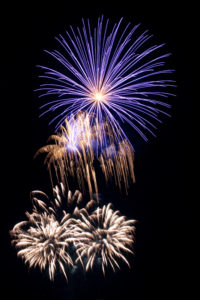 Check the image on the camera. if it’s too dark, open the lens to f5.6. If too light and washed out, close the aperture to f11 or f16. The try another sequence. You may want to remove the lens cover 5 or 6 times to really fill the sky with colour.
Experimenting is half the fun. Give it a try and post your results below. I’d love to see some of your efforts and we will include the best ones in our next newsletter.

